Mount Rainier is located in the US State of Washington, and is certainly one of the most beautiful and majestic peaks in the entire
United States. Rising 14,411 feet above Puget Sound, it stands tall above it's beautiful surroundings and claims the title of the highest
volcano in the contiguous United States. Mt Rainier was recognized early on as a place to be preserved, and on March 2, 1899, it
became a National Park.
Mt Rainier has also become an irresistible attraction for climbers from all over the world. Steep glacial ice, crevasses, serious elevation
gains, and much, much, more have challenged climbers of all abilities over the many years since the first documented climb on
August 17, 1870, by General Hazard Stevens and Philemon Beecher Van Trump.
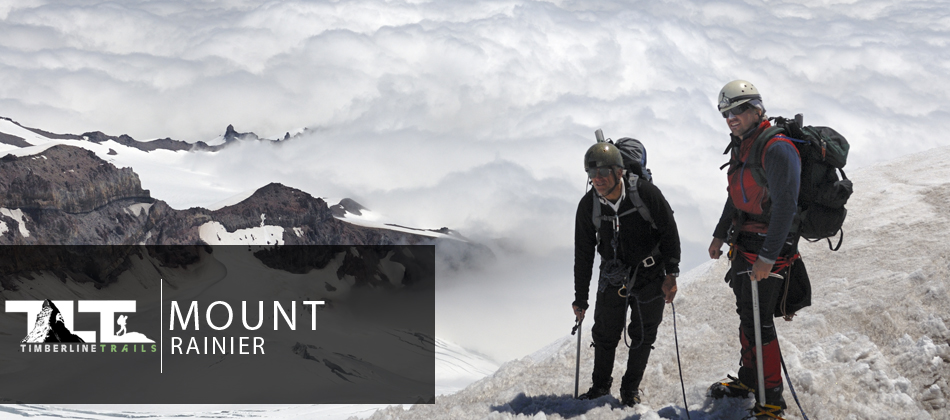
 To the left you see a climber just above the cloud
level at 10,000 ft with Mt Adams in the
background. Mount Rainier has a topographic
prominence of 13,211 feet, which is greater than
that of K2 (13,189 feet. Mt Rainier ranks 21st in
the world on this scale and on clear days it
dominates the southeastern horizon in most of the
Seattle-Tacoma metropolitan area. The mountain
can be seen from as far away as Portland, Oregon,
and Victoria, British Columbia.
To the left you see a climber just above the cloud
level at 10,000 ft with Mt Adams in the
background. Mount Rainier has a topographic
prominence of 13,211 feet, which is greater than
that of K2 (13,189 feet. Mt Rainier ranks 21st in
the world on this scale and on clear days it
dominates the southeastern horizon in most of the
Seattle-Tacoma metropolitan area. The mountain
can be seen from as far away as Portland, Oregon,
and Victoria, British Columbia.
As far as weather is concerned, Mt Rainier seems
to make it's own weather, and because it stands in
the path of prevailing moisture laden marine
winds, it's southern slopes get some world
breaking snow fall, and Paradise Inn (a three story
lodge) is frequently buried to the tops of it's
chimneys in snow.
Due to the heavy snowfall on the slopes of Mt
Rainier (mentioned above), the mountain sports 26
major glaciers covering more than 35 square miles,
and claims the title of the largest single-mountain
glacier system in the United States outside of
Alaska. The Emmons Glacier, which is nearly five
square miles in area, is the largest glacier in the
nation outside Alaska. The Carbon, Tahoma,
Winthrop, and Ingraham are second in line, and
take up approximately four square miles each.
To the right you see a climbers on the Muir
Snowfield with the Nisqually Glacier in the
background. Because of the sheer number of
glaciers on Rainier, it is not possible to reach the
summit without crossing one of it's many glaciers.
Climbers gain 2,800 vertical feet on the snowfield
from Pebble Creek to Camp Muir.
Climbing on Mount Rainier is difficult, involving traversing the largest glaciers
in the U.S. south of Alaska. Most climbers require two to three days to reach
the summit. Climbing teams demand experience in glacier travel, self-rescue,
and wilderness travel. Ninety percent of climbers use the Camp Muir
approach on the southeast side, and most of the rest ascend Emmons Glacier
via Camp Schurman on the northeast. About half of the attempts on Mt
Rainier are successful. Weather and conditioning are the most common
reasons why climbers fail to reach the summit.
About three mountaineering deaths each year occur due to rock and ice fall,
avalanche, falls, and hypothermia associated with severe weather. The worst
mountaineering accident on Mount Rainier occurred in 1981, when eleven
people lost their lives in an ice fall on the Ingraham Glacier. This was the
largest number of fatalities on Mount Rainier in a single incident since 32
people were killed in a 1946 plane crash on the South Tahoma Glacier.
A few days before our climb on Mt Rainier, on July 6th, 2010, a man lost his
life near the summit, due to cold and extremely high winds. And then, three
weeks later, after we returned from our climb, four climbers fell on the
Emmons Glacier, and went into a 35 foot crevasse where one of the climbers
lost his life in the fall.
To the left, you see a climber practicing on a steep snow and ice slope just
outside the Camp Muir area. Mt Rainier is certainly a great place to practice
your snow and ice skills. But be warned, that Mt Rainier, as stated above, can
be deadly and novice climbers should not attempt to climb Mt Rainier without
proper training and guidance.
Mt Rainier is a technical climb, and proper skills
are required. Proficiency with an ice axe,
crampons, roped glacier travel, crevasse rescue,
and other skills are a must. Many mistakes are
made when beginners take on any sport, but
usually mistakes do not cost one his life in most
sports. But mountaineering is different in that the
mountain does not care about your inexperience,
and will not give you any special considerations
when a mistake is made. Thus, climbers every
year loose their lives on Mt Rainier.
To the right you see a climber crossing over a
good sized crevasse on a ladder on the Ingraham
Glacier at about the 11,600 ft level. An un-roped
fall off the ladder could very likely be fatal. All
glacier travel should be done roped. This is why
solo climbs on Rainier are extremely dangerous.
Reaching the summit requires a
vertical elevation gain of more than
9,000 feet over a distance of eight
or more miles. Climbers must be in
excellent physical condition and well
prepared. I cannot emphasize
enough the importance of
conditioning. It can make the
difference between success and
failure, and even more importantly,
it makes a difference when it comes
to your safety. Overly tired climbers
are far more likely to make
mistakes. For more on this subject,
please visit our page on
Conditioning.
Also, weather, snow, and route
conditions can change rapidly.
Severe winter-like storms on the
mountain are not uncommon, even
during the summer months.
Mt Rainier is a place of wonder and beauty. It is a world of alpine ice and
rock, and holds a beauty all it's own. I have climbed many peaks in the
Western United States, and I have to say that Rainier ranks very high on my
list when it comes to mountain adventure. There are pinnacles of ice,
jumbled ice blocks the size of houses, deep crevasses, pristine forests, and so
much more.
The base of Mount Rainier spreads over an area of 100 square miles. The
scenic area around Rainier covers more than 230,000 acres.
While it's great to enjoy the views of the ice-covered summit of Mt Rainier,
the best way to enjoy the mountain is to climb it. But inexperienced climbers
or novices should not attempt Mt Rainier. It is certainly no place for
beginners. But even for non-climbers, the towering giants of the old growth
forests and colorful wildflower meadows with views of the peak are just as
rewarding in their own ways.
In this section of Timberline Trails, we would like to take you on an
adventure to the top of Mt Rainier using the Ingraham Glacier Direct
Route/Disappointment Cleaver. These are the most popular routes on the
mountain, and are considered true Rainier classics and offer stupendous
views of Gibraltar Rock and Little Tahoma. The elevation gain is substantial,
however, being 9,000 vertical feet from Paradise.
So whether you are a climber or not, we hope that you will enjoy exploring
this section of Timberline Trails, and that you will be inspired by this
beautiful mountain that makes up part of God's wondrous creation.
To provide a pathway into the vastness of God's wonderful creation where you can escape from the routine of everyday life and journey in a
world of amazing beauty and adventure. It is our hope that you will be both renewed and inspired by your experience, as we invite you to
tread on the very threshold of life...life at Timberline.
Read More
Curabitur scelerisque mauris quis diam gravida eu placerat ligula scelerisque. In vitae sem nec massa imperdiet condimentum. Donec ut mauris vel risus rutrum commodo. Duis sed massa id urna varius. Fusce nibh sapien, porttitor sed euismod in, aliquet eget lorem.
- Donec ut mauris vel risus rutrum commodo.
- Fusce nibh sapien, porttitor sed euismod inaliquet eget lorem.
- Curabitur scelerisque mauris quis diam gravida
- Placerat ligula scelerisque.
- In vitae sem nec massa imperdiet condimentum.
Curabitur scelerisque mauris quis diam gravida eu placerat ligula scelerisque. In vitae sem nec massa imperdiet condimentum. Donec ut mauris vel risus rutrum commodo. Duis sed massa id urna varius. Fusce nibh sapien, porttitor sed euismod in, aliquet eget lorem. Curabitur scelerisque mauris quis diam gravida eu placerat ligula scelerisque.